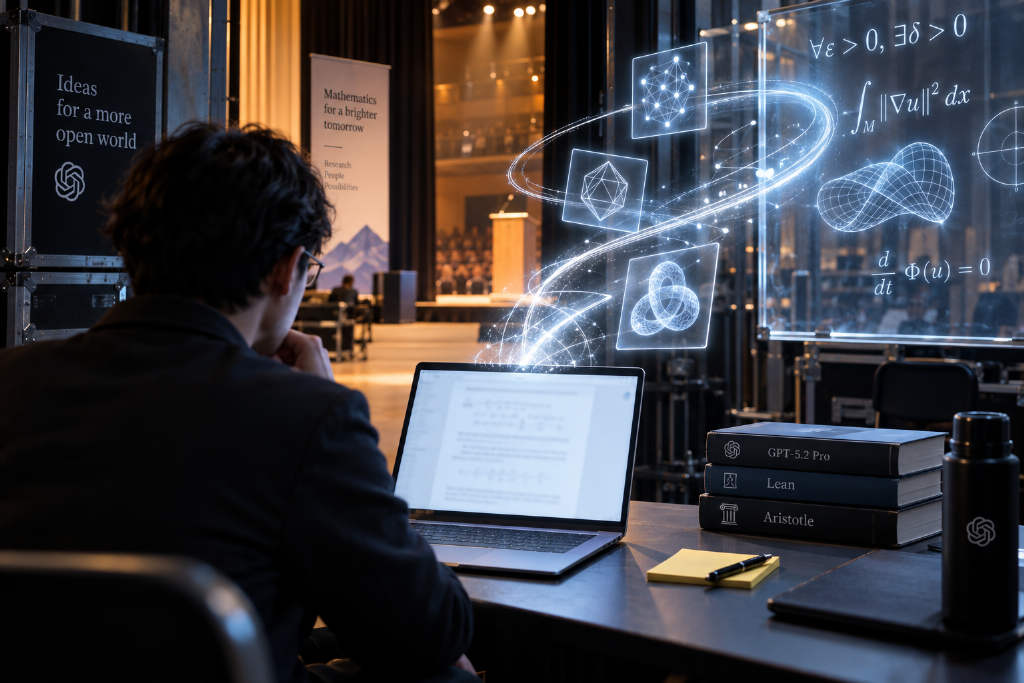
Terence Tao2026-09-09 10:28:47Terence Tao says AI works like a helicopter in math, dropping researchers near the answerTerence Tao said artificial intelligence has moved into the workflow of top mathematicians and is no longer limited to literature search or coding support. Speaking in a conversation with Ken Ono, Tao described AI as "a helicopter" that can drop researchers near the answer to a hard problem, while stressing that mathematics is not only about reaching the destination but also about building the path, mapping the terrain, and making results understandable to other people. The discussion cited several recent examples. In January, GPT-5.2 Pro and the formal mathematics system Aristotle solved Erdős Problem #728, with the proof verified in Lean. In May, an OpenAI model overturned a long-standing conjecture in the planar unit distance problem, originally posed by Paul Erdős in 1946. More recently, Lech Mazur used AI to solve the decades-old Sendov conjecture, again with Lean used for verification, and Tao later helped reorganize the proof into a version that humans could read more easily. Tao also said the hardest part of mathematical research may be shifting from finding answers to understanding them. As proof generation becomes more automated, he argued, mathematicians will need to focus more on verification, explanation, and placing new results inside the broader structure of mathematical knowledge.520
AI2026-08-20 11:03:11Terence Tao and Wang Hong say math needs to learn how to absorb AI-generated proofsArtificial intelligence is producing mathematical proofs faster than the field can comfortably process, and that shift is forcing a debate over what counts as a complete mathematical result. In comments highlighted by MarsBit, Fields Medalists Terence Tao and Wang Hong arrive at much the same conclusion: mathematics cannot ignore AI-generated counterexamples or proofs, but it also cannot stop at machine output. Results still have to be understood, organized, explained, and absorbed by human researchers before they become fully usable. Tao’s recent work on the 67-year-old Sendov conjecture is presented as a concrete example. After math enthusiast Lech Mazur used AI to fill the long-open middle range of the problem and produced a Lean-verified formal proof, Tao spent several days reworking the result into a form mathematicians could actually read and use. According to the source text, that process not only clarified the proof but also extended it to the stronger Phelps–Rodriguez conjecture, while reducing the Lean code from about 90,000 lines to 15,000. Tao is also pushing a broader change in incentives. He argues that the field should place more value on digesting, explaining, reviewing, and integrating proofs, not just being first to announce them. He has also opened Palomar, a registry for Lean-verified results that records proof statements, code, AI involvement, and version details as a bridge between verification and formal publication.850